〜 (updated: November 7, 2026)
Four Days on the Kunisaki Peninsula Minemichi Long Trail — A Walk I Didn't Finish
A 4-day hike on the Kunisaki Long Trail in Oita: Nakayama Senkyo's chains, stone Buddhas, the people who helped, and honest lessons from a trip I didn't finish.
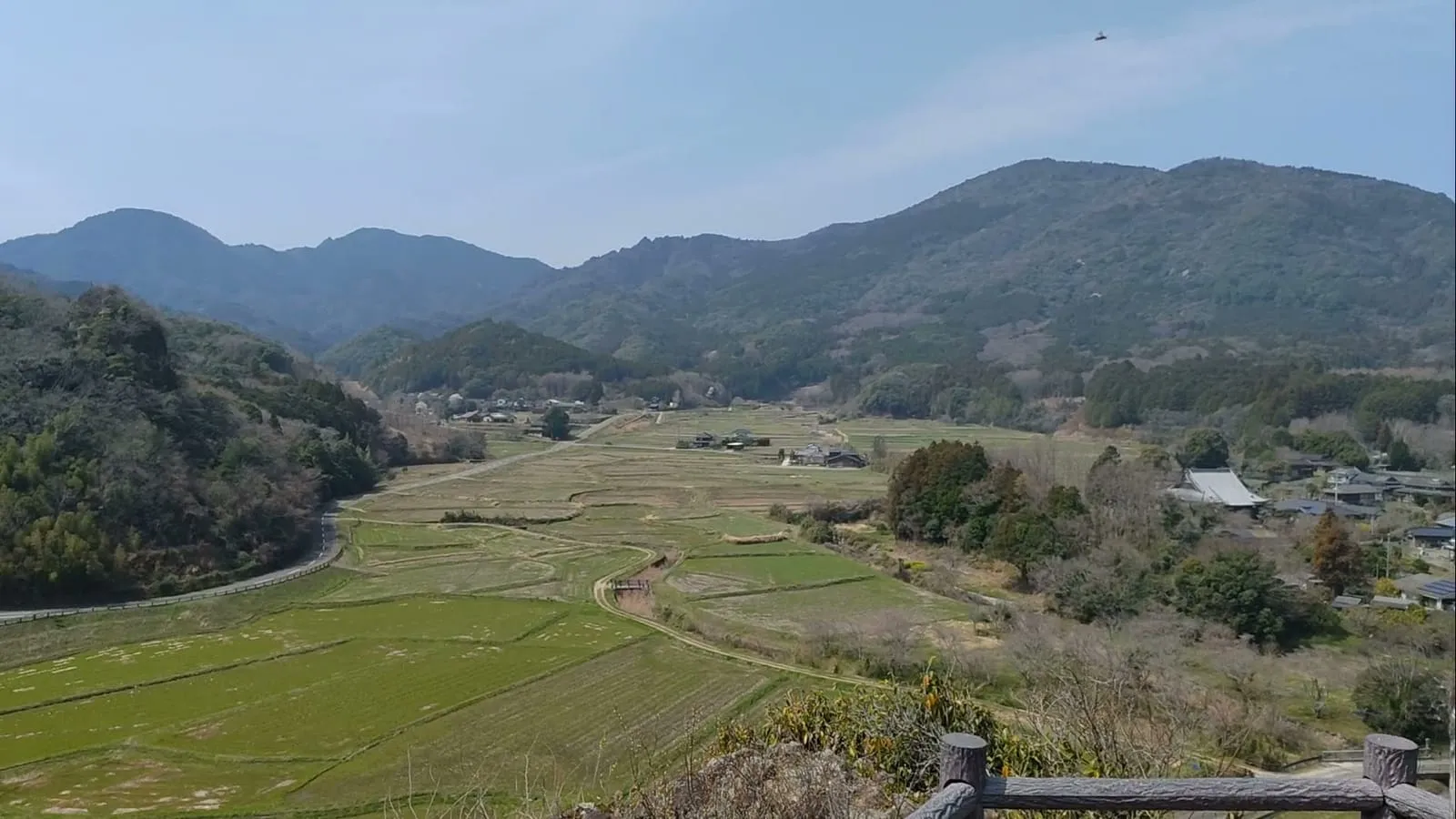
The Kunisaki Peninsula Minemichi Long Trail winds along the ridges of the Kunisaki Peninsula in northeastern Oita, on the island of Kyushu. In March 2026, I spent four days walking it. I’ll say it up front: I didn’t make it to the end. But if you read to the end, I think you’ll understand why I still wanted to write about this trail.
The trip at a glance
| Day | Route | Things to know about this stretch |
|---|---|---|
| Day 1 | Tashibu-Nakamura bus stop → Maki-odo → Tashibu no Sho → Kozan-ji → Fuki-ji (T-1 to T-2) | No lodging or campsites nearby. Start at midday and you won’t reach lodging before dark |
| Day 2 | Fuki-ji → Nameshi Dam → Choan-ji → Tennen-ji → Matama Onsen (T-2 to T-3) | First chains at Tennenji-yaba. Tennen-ji and Matama Onsen are about the only places to eat |
| Day 3 | Mt. Inomure → Nakayama Senkyo (T-4); Monjusen-ji → Gyonyu Dam (K-3) | Nakayama Senkyo has chains and narrow rock ridges. No shops nearby to buy food |
| Day 4 | Gyonyu Dam → Houon-ji Temple Park (K-4) | A shop near the park. I stayed at Minpaku Musashi and ended the trip here because of illness and rain |
Distances for each section, and where to find water and lodging, are in the Kunisaki Peninsula Minemichi Long Trail Guide.
Day 1 — Rapeseed fields, Tashibu no Sho, and the cat of Fuki-ji
The first day got off to a late start. I’d been in Hakata, Fukuoka, the day before, so in the morning I took the shinkansen to Kokura, changed to a limited express, and got off at JR Usa Station in Oita. From Usa I took a bus to the Tashibu-Nakamura stop. (Bus and taxi options are in Access.) By the time I arrived, it was already past 11 a.m.
When I stepped off the bus, there was truly nothing there. Yet the roads were well kept, and fields stretched out all around. Torii gates and small shrines appeared everywhere, and the air felt somehow different from anywhere else. In Japan, you rarely feel extreme cultural differences from one place to the next. But standing here, the first things I felt were a great sense of openness and the depth of accumulated history.
It was a clear March day. After walking along the road for a while, I came upon fields of yellow rapeseed flowers stretching along the roadside — a breathtaking scene that told me spring had arrived. For a body that had only just started walking, that yellow was exactly what I needed.
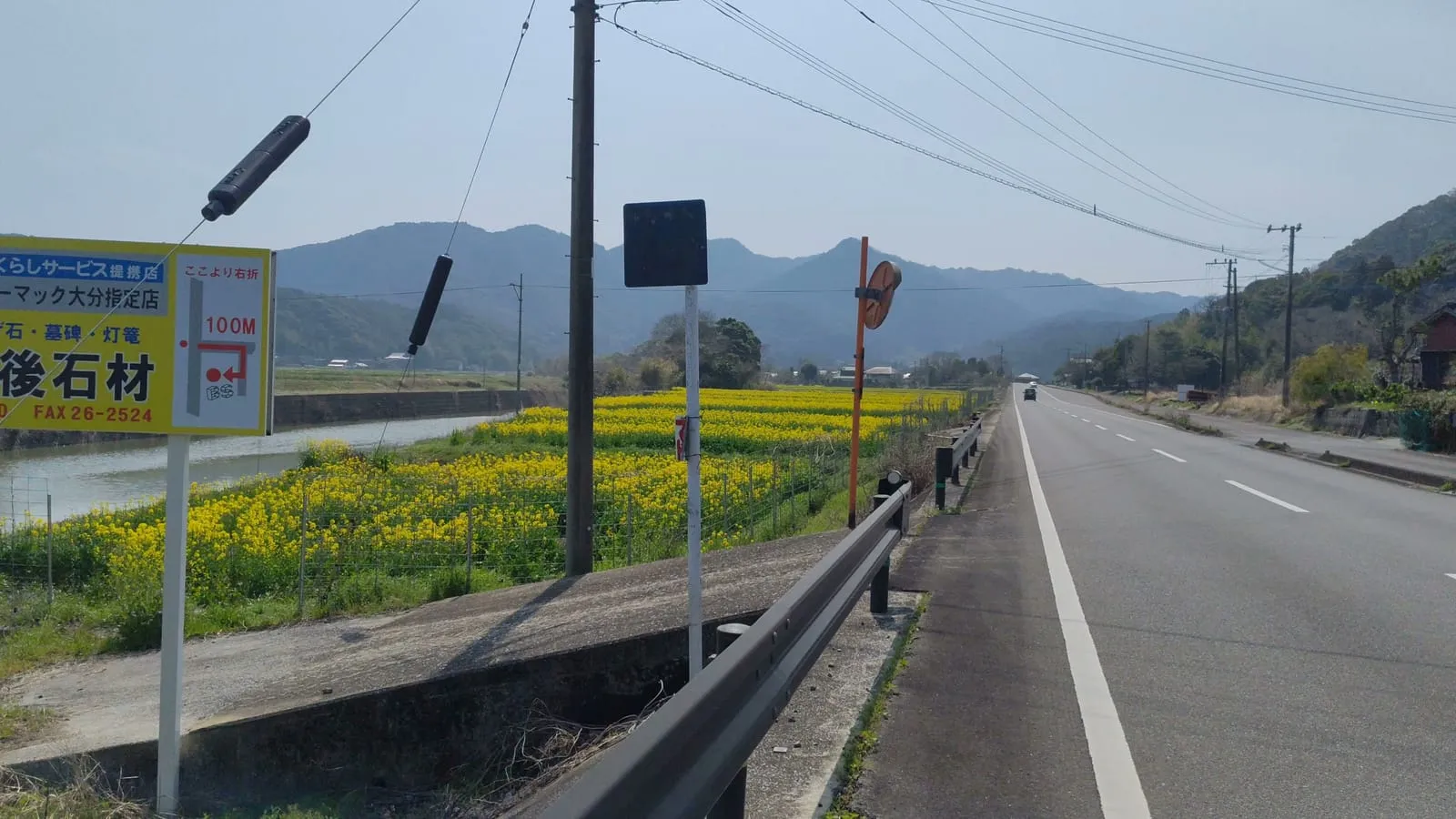
The first checkpoint was Maki-odo Temple. That meant I started one point after the official start at Kumano Magaibutsu. From there the trail entered a forest road. Bare rock showed through here and there, unlike an ordinary mountain, and yet the path itself was neatly maintained. With that odd feeling, I kept walking.
Then I reached the place that moved me most that day: Tashibu no Sho. Its name is written with the characters for “rice field” and “to dye.” The view of rice fields here deserves to be called the original landscape of Japan. It was soothing, and at the same time it left me speechless. All I could think was: “How did I get to come somewhere this wonderful?”
From Tashibu no Sho, the trail went down for a while and climbed again to Kozan-ji Temple. Here, for the first time that day, I got to talk with someone. The resident priest kindly spent about 30 minutes with me, sharing the history of the area, how the Minemichi came to be, and the role Kozan-ji has played. (I wrote up that conversation in “The Mount Hiei of the West.”)
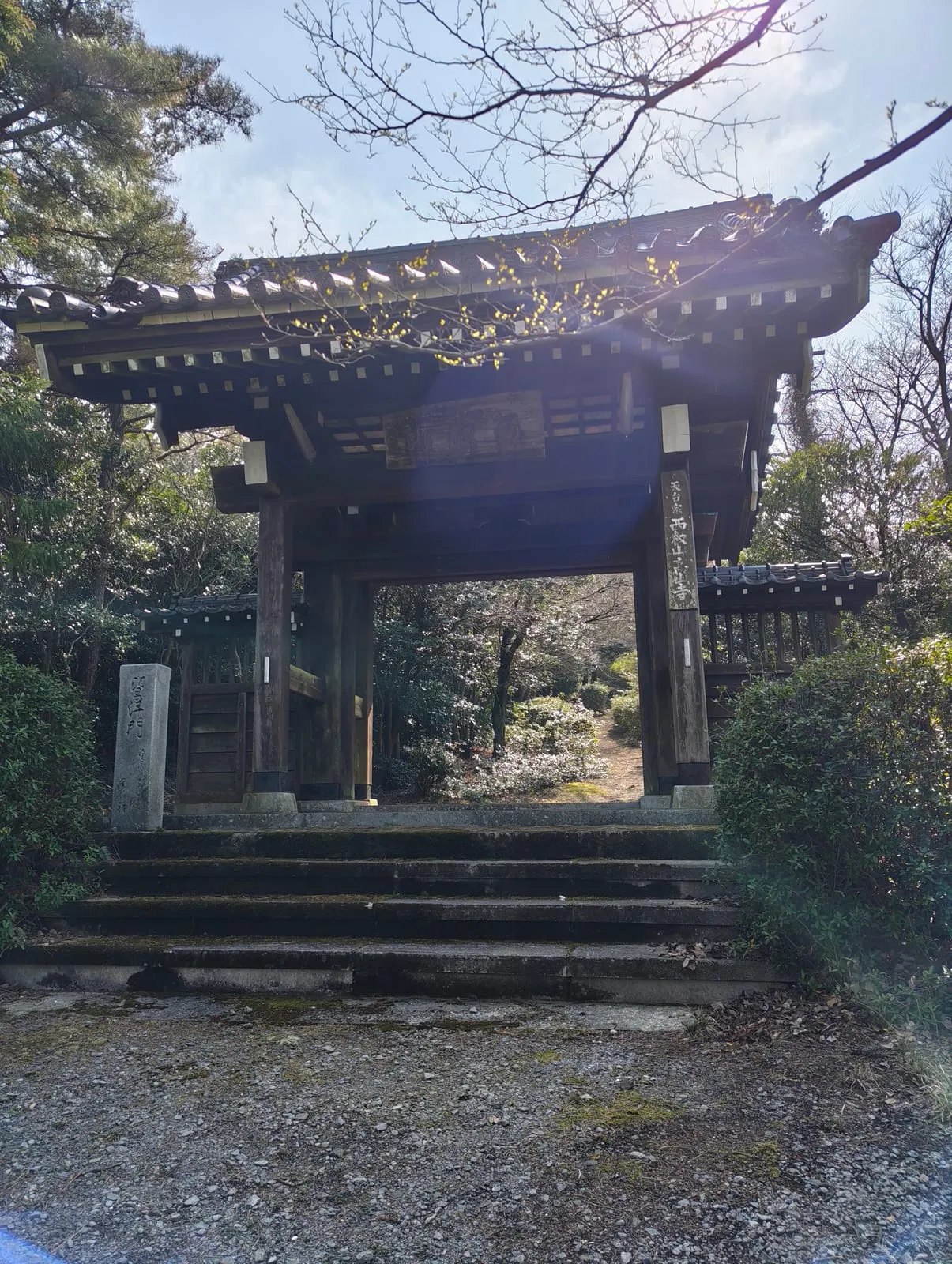
Because I’d started at midday, finding a place to sleep that night was a struggle. There were no inns or campsites nearby, and as the sun began to set I started to panic. After a while I reached a village and Fuki-ji, a temple known for its main hall, a National Treasure. Thanks to the kindness of local residents, I was able to spend the night near Fuki-ji.
As I was unpacking, the temple’s cat took a strong liking to me. It stayed by my side the whole time — while I got ready and while I relaxed afterward. It was a strange encounter.
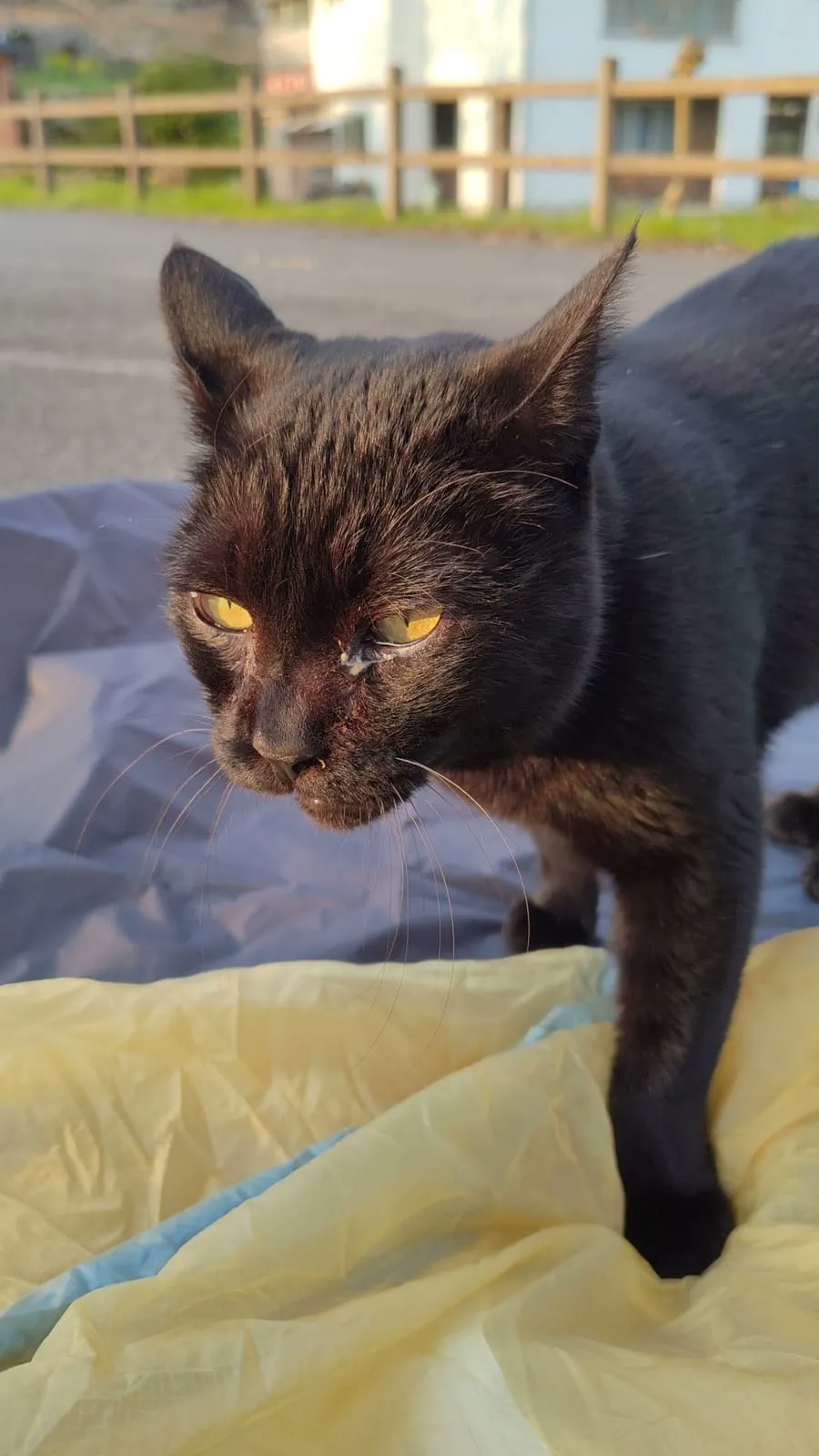
That night, something happened. Around 2 a.m., I was woken by furious meowing. Annoyed, I looked outside — it was pitch dark and I couldn’t see a thing. Then, right in front of me, there was a thud. When I turned on my light, a dead mouse was lying there. A gift from the cat, perhaps? Surprise, bewilderment, a little fear and a little irritation all mixed together as the first night wore on.
Day 2 — A mountain shrine, dogs with bells, and my first chains
I woke up near Fuki-ji and set off in the morning. The morning view reminded me of mornings on the Kumano Kodo: rice fields on both sides of a wide road, with a few scattered houses. It was another clear day.
Before reaching Nameshi Dam, I stopped at several shrines. The two that stayed with me were Yama Shrine and Watatsumi Shrine.
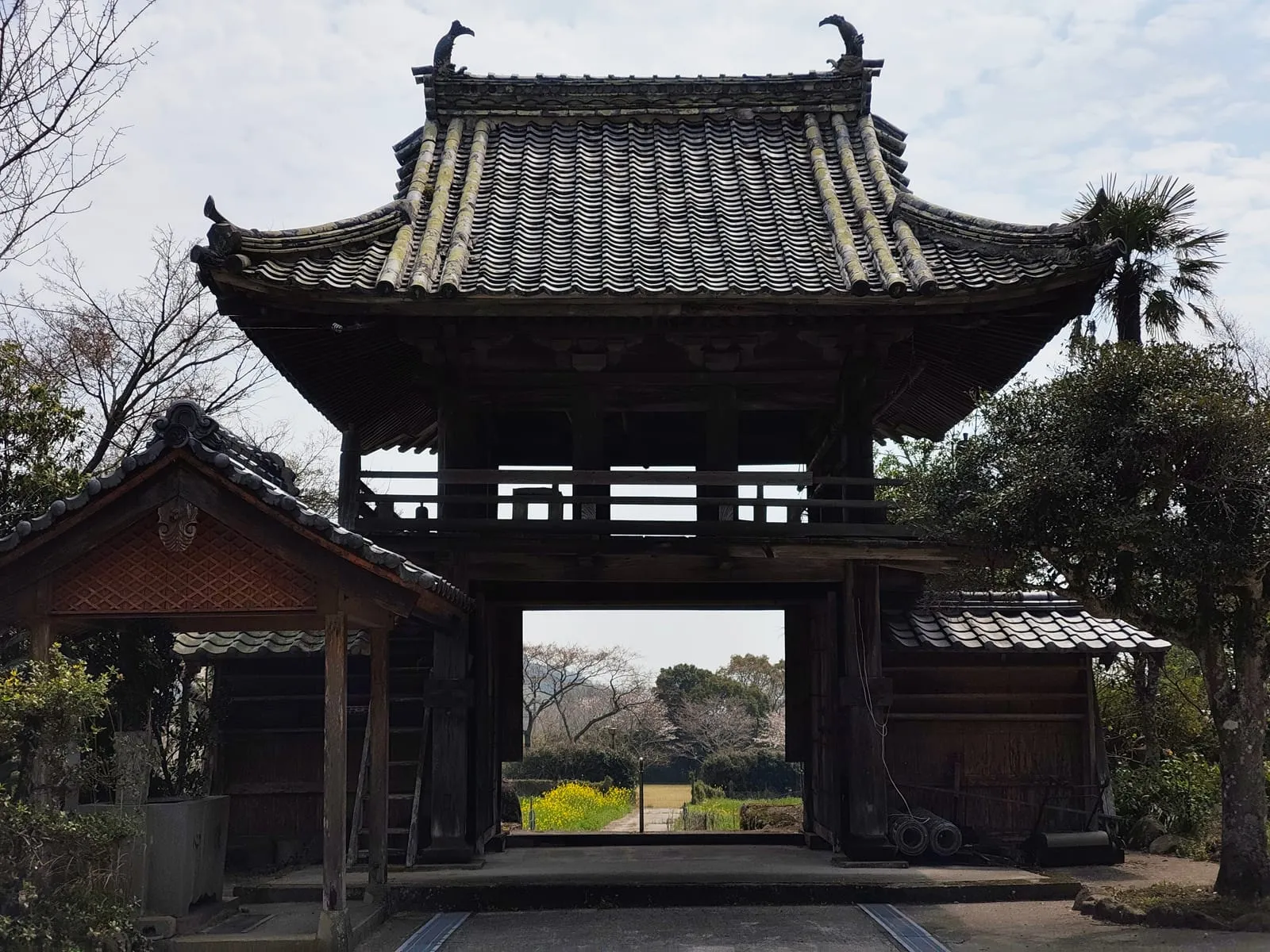
Yama Shrine stood in the mountains among rows of cedar trees. The shrine itself was somewhat run-down and quiet. But its torii gate carried an extraordinarily sacred air. A long stone stairway ran up the steep slope, with the torii standing partway up. The weather and time of day may have helped, but the scene felt almost divine, and I ended up taking photo after photo.
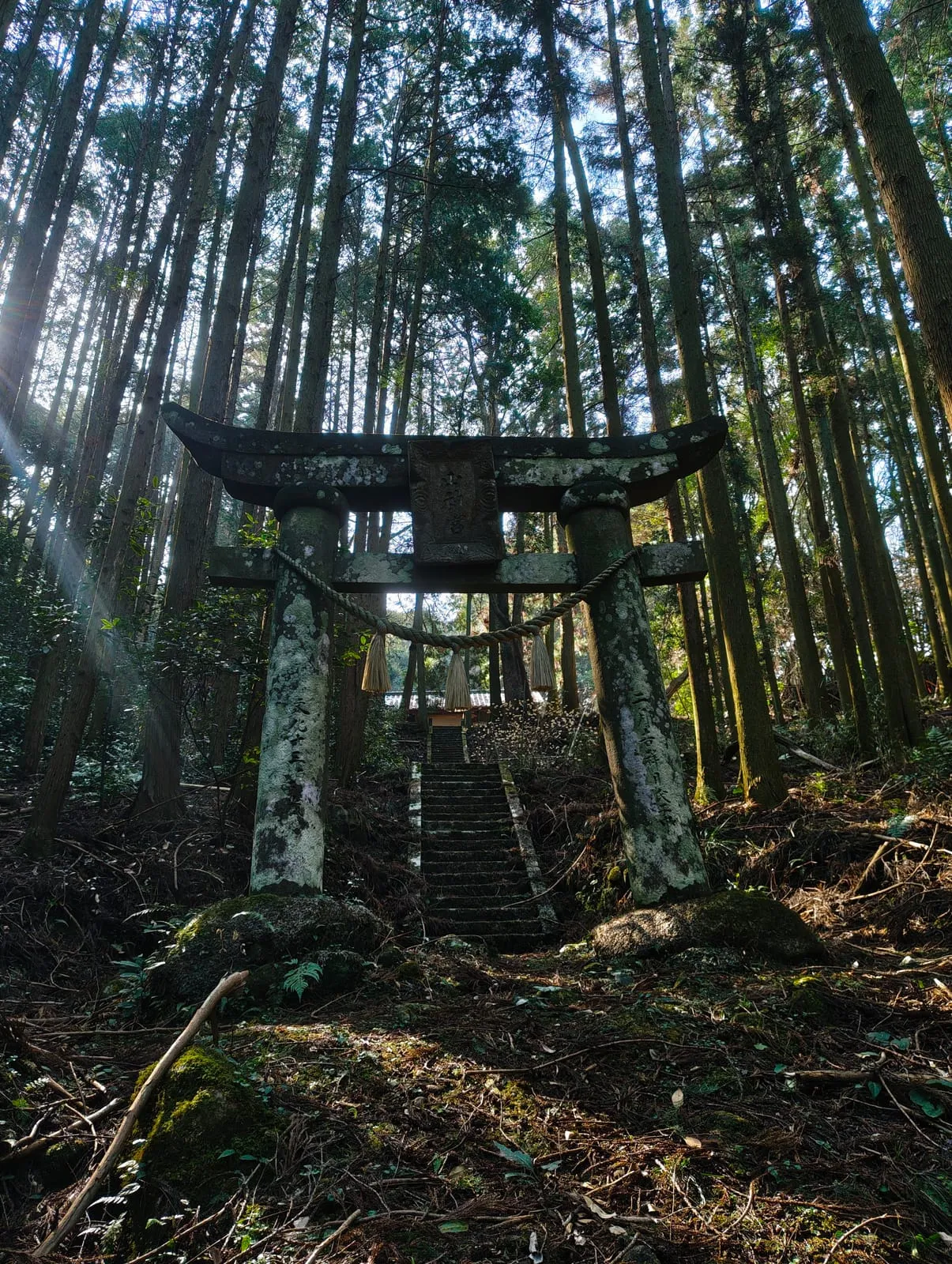
Just before Watatsumi Shrine there was a place raising cattle — less a ranch than a dairy barn for milking — and I caught a glimpse of the cows. Watatsumi Shrine sits at the top of a long flight of stone steps. There wasn’t a soul around, which only made it feel more sacred.
Around 10 a.m., I reached Nameshi Dam. Next to the dam is a campsite called Cotton Village.
All along the way that day, I passed graves, and each one was remarkably grand. They were built in a style you almost never see in Tokyo, and above all they were beautifully kept. The flowers left on them were fresh, and it was clear they were cleaned regularly. Kunisaki is a land of Shinto-Buddhist fusion, where gods and Buddhas have been worshipped together. Perhaps it’s because prayer has long been part of everyday life here that graves are cared for so well. That’s what I found myself thinking as I walked.
On the forest road to Choan-ji Temple, something funny happened. I heard bells ahead of me. A hiker, or someone local? I kept walking — and what came running toward me were two dogs with bells on their collars. They weren’t strays; they seemed to be playing, running up and down the forest road. They were so adorable that all my tension melted away.
When I arrived at Choan-ji, the priest served me tea.
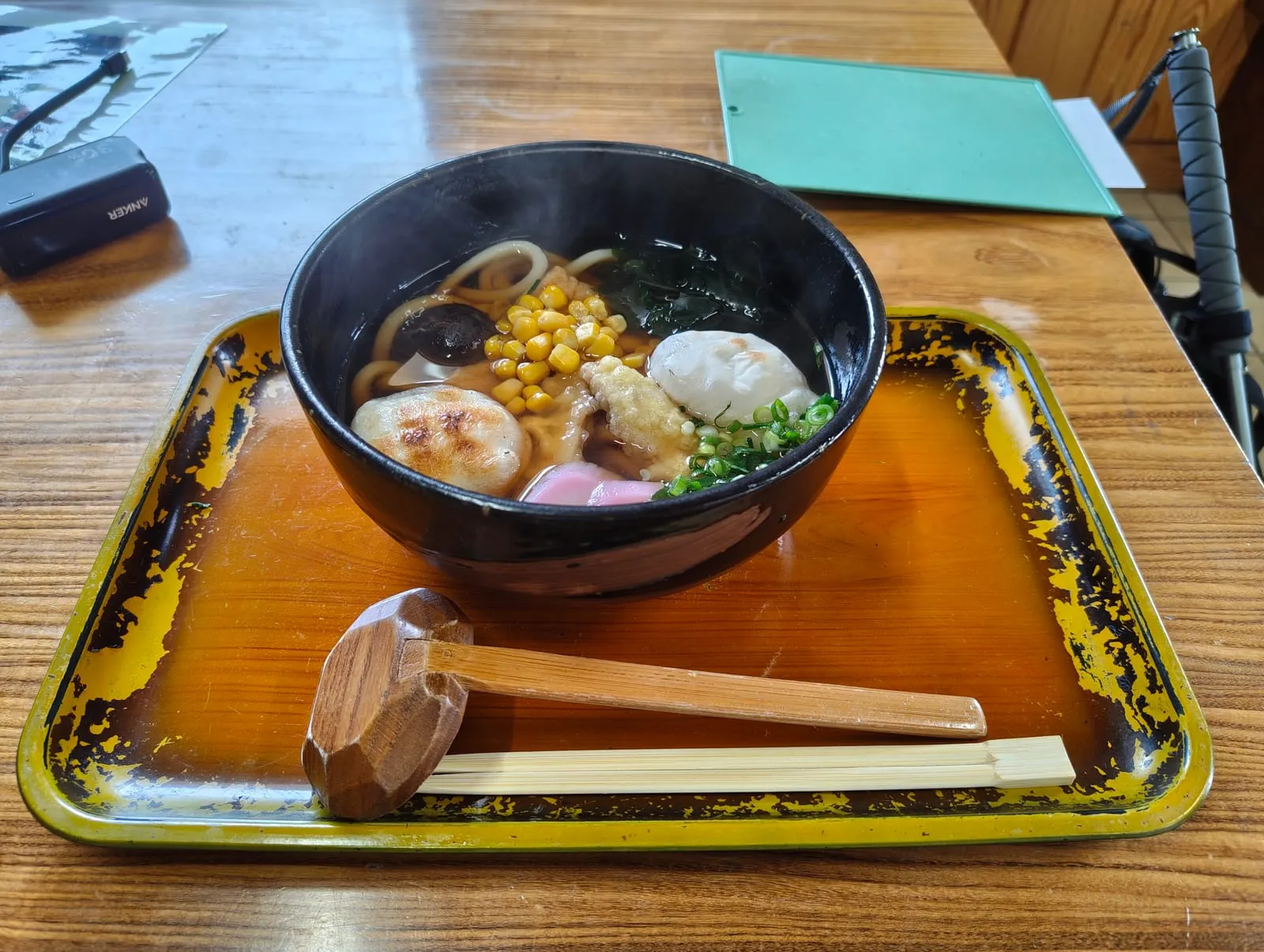
I walked on to Tennen-ji Temple. Known as Onie no Sato, the home of the Shujo Onie fire festival, it’s a famous temple that’s even included on sightseeing tours. At the restaurant there, I went into a place to eat for the first time on this trip and had a bowl of udon.
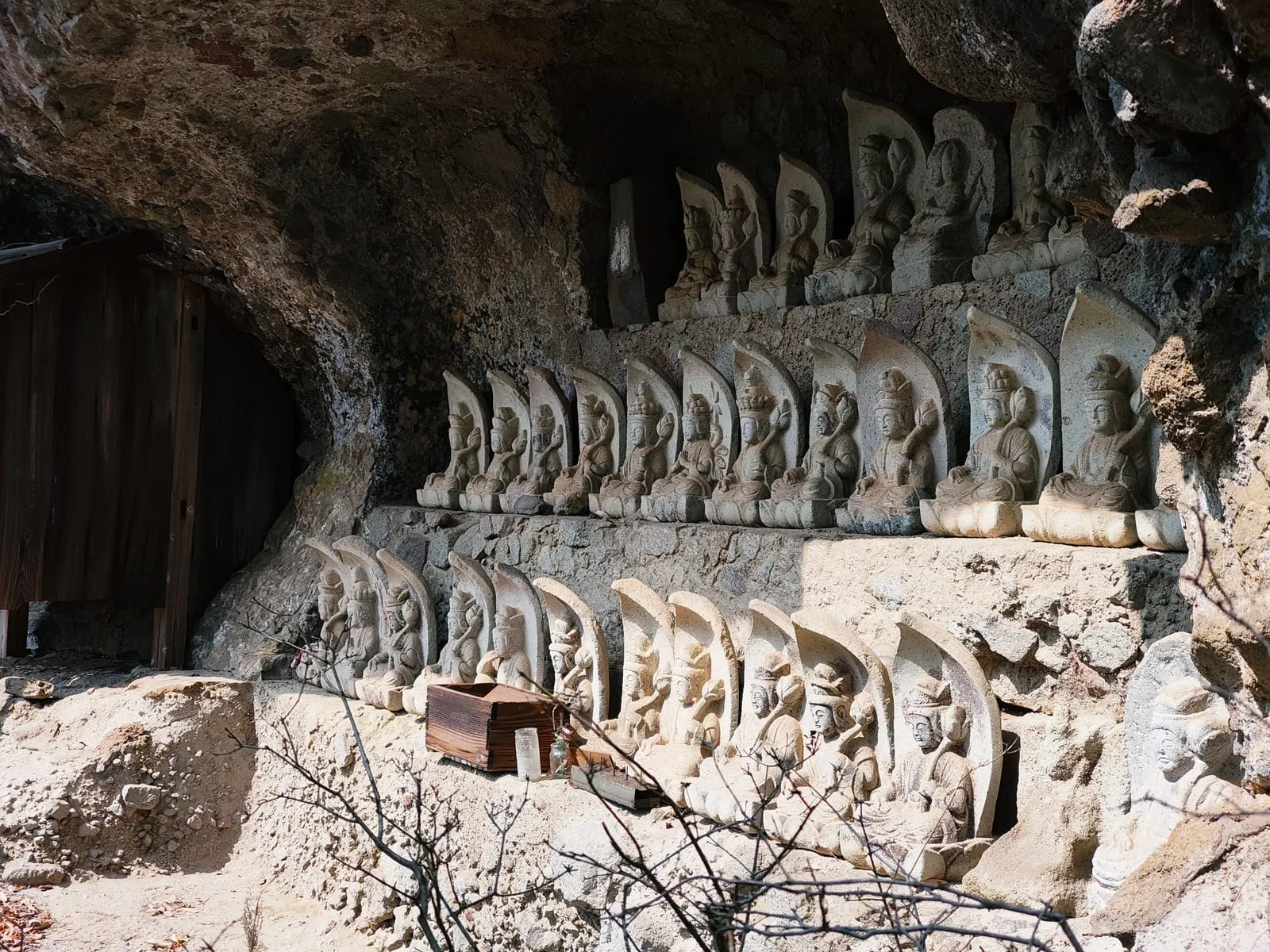
From Tennen-ji, the trail climbs the rocky mountain behind it, known as Tennenji-yaba, home to a stone bridge called Mumyo Bridge (I didn’t cross the bridge itself). Just before it came the first chain section of the trip. To be honest, I was terrified. Trembling, I gripped the chains and climbed one step at a time.
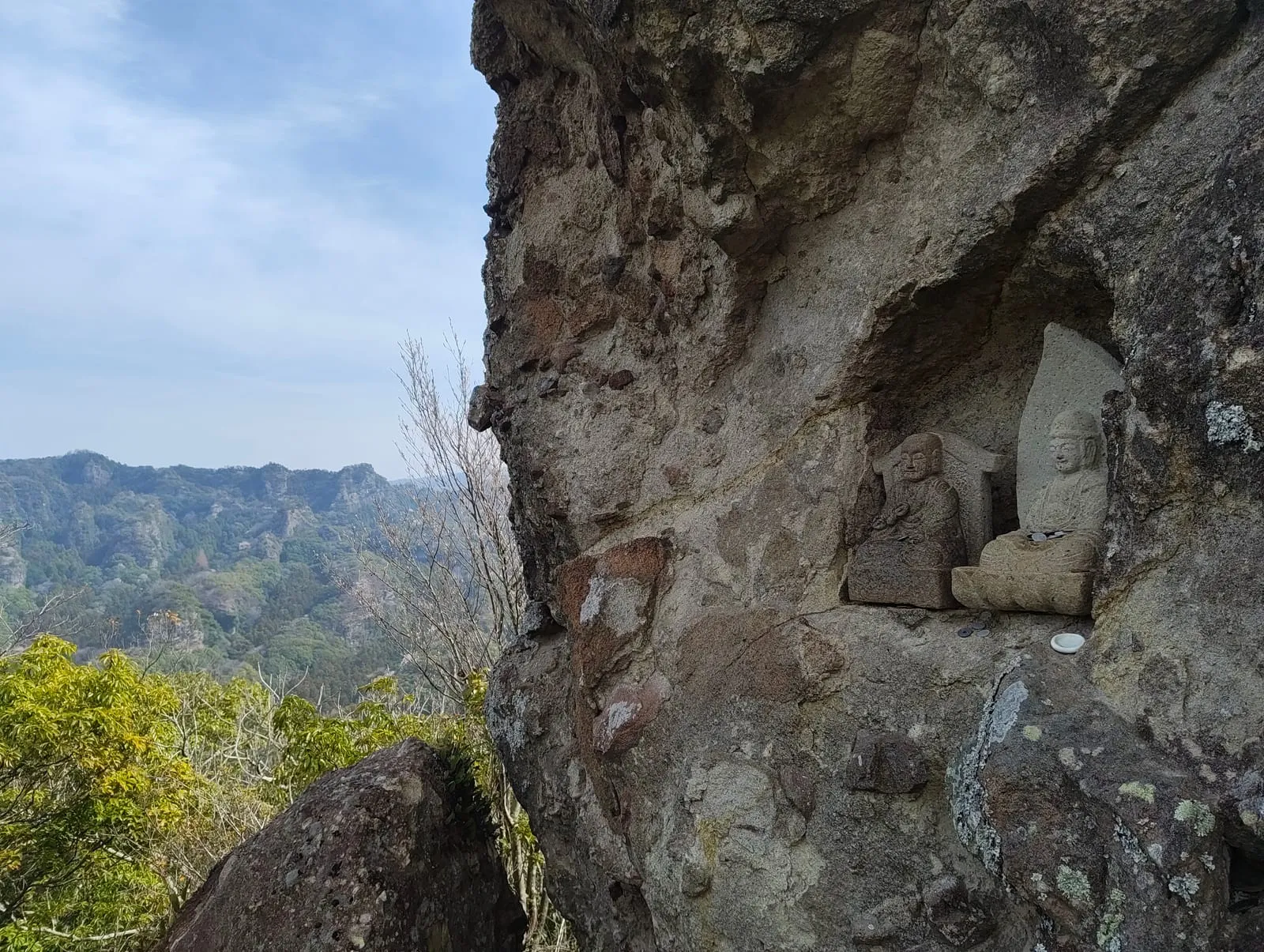
At the top was a place where stone Buddhas lined the rock face. I was so scared I found myself pressing my hands together to pray to them. But the view in front of me was truly picture-perfect — rock, Buddhas and prayer all in one, the very essence of Kunisaki. I think it was the highlight of the whole trip.
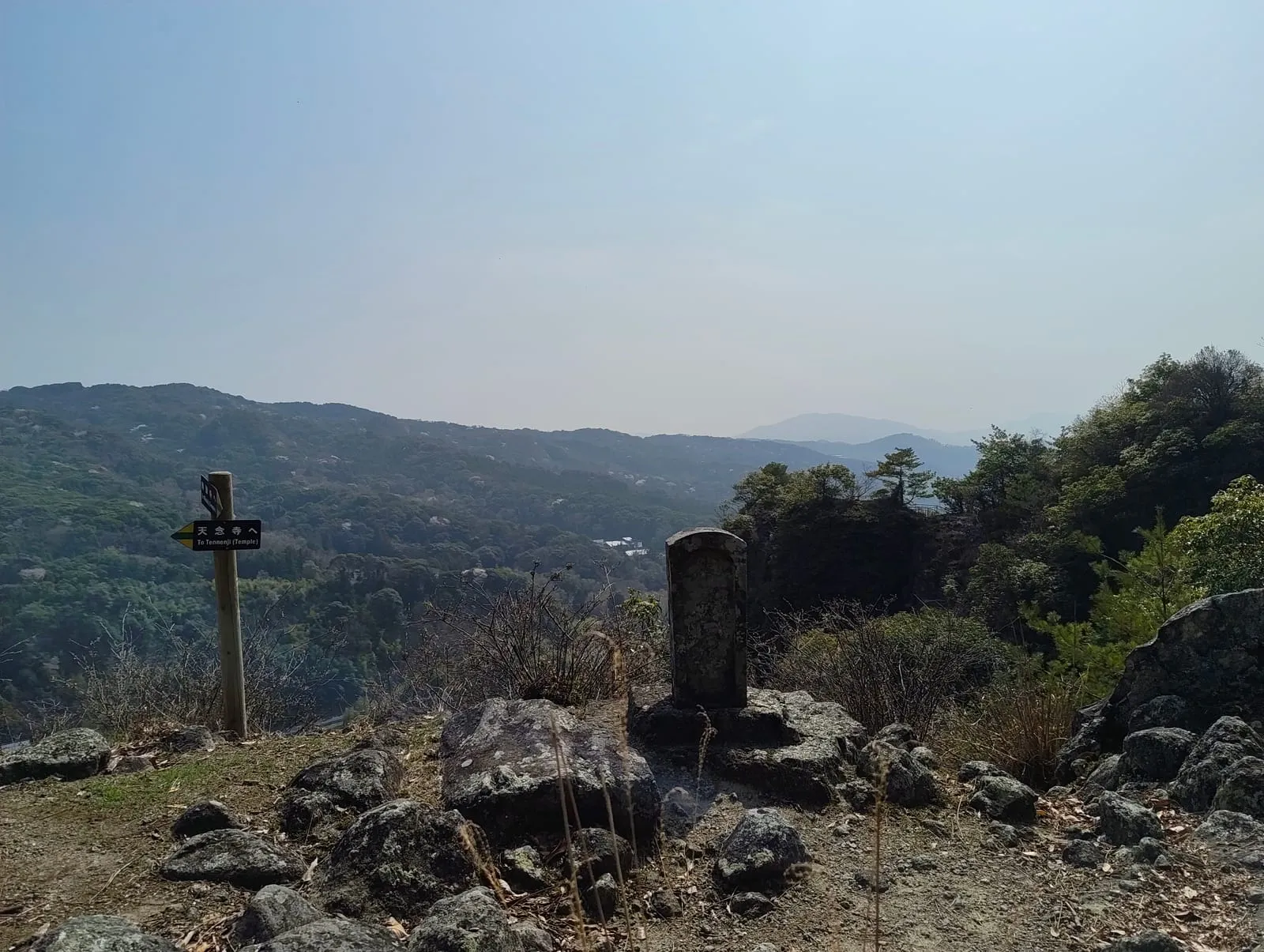
Coming down the mountain, I reached a road, and walking along it I came to Matama Onsen Sansui-so (Spaland Matama). On day two, I finally got to soak in a hot spring. It felt wonderful.
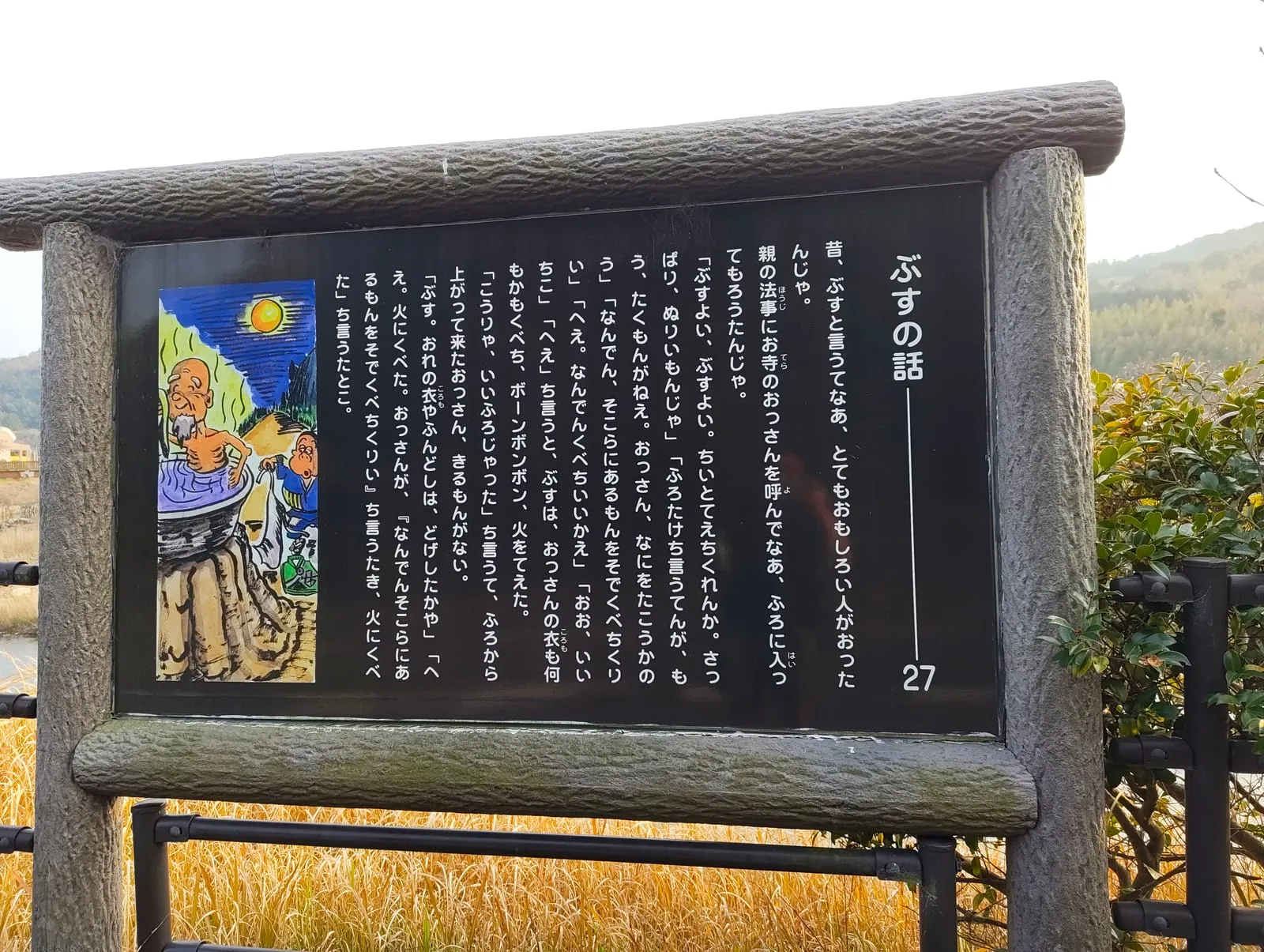
Along that road there were also some fun signboards. Each one told a slightly silly folk tale passed down in the area, and about ten of them were lined up along the way. Reading them as I walked was a delight.
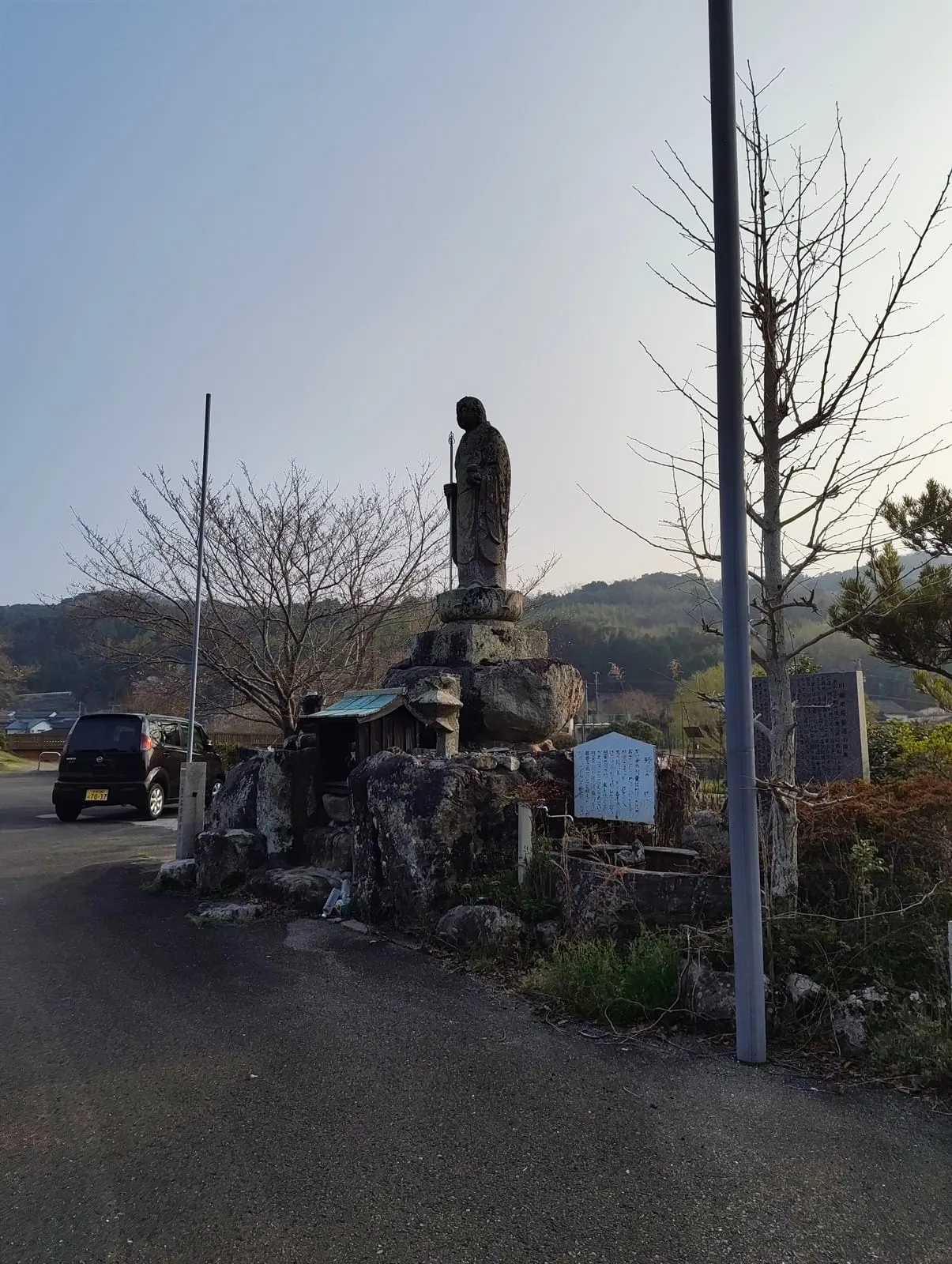
That night I stayed at the Mt. Inomure trailhead. In short, it was pretty frightening too. No people, no passing cars. There was a small hut that wasn’t on any map, its door wide open, but no one inside. While I was searching around to see if anyone was there, the sun began to set, so I hurried to get ready for the night.
Only one car was parked there. It was getting dark, and still its owner didn’t come back. I was so scared that my imagination started running to some dark places. But eventually a pair of hikers returned, and when I spoke to them they turned out to be very friendly. They even shared sweets and bread with me, and before I knew it my fear had turned into happiness.
That night, it wasn’t a cat that woke me but deer. Their shrill calls echoed again and again through the dark mountains. Sleeping in nature is harder than I’d imagined. It takes skill, stamina, and the mental strength not to give in to anxiety. Even the place where you sleep, I felt, puts you to the test.
Day 3 — The chains of Nakayama Senkyo, and the people I met by the road
I didn’t wake up in a good mood on day three. Partly it was where I’d slept; the other reason was pollen. I’d felt fine on day one, but by days two and three my nose was getting worse and worse. I was clearly unwell, and I could feel my energy being chipped away with every step.
The day began straight from the trailhead with a climb up Mt. Inomure, 458 meters high. I learned firsthand that warming up matters, even in hiking. If you walk a little first and then reach the steep part, it’s manageable. But when the climb is steep from the very start, your heart rate shoots up. By the time I reached the summit, a lot of my energy was already gone.
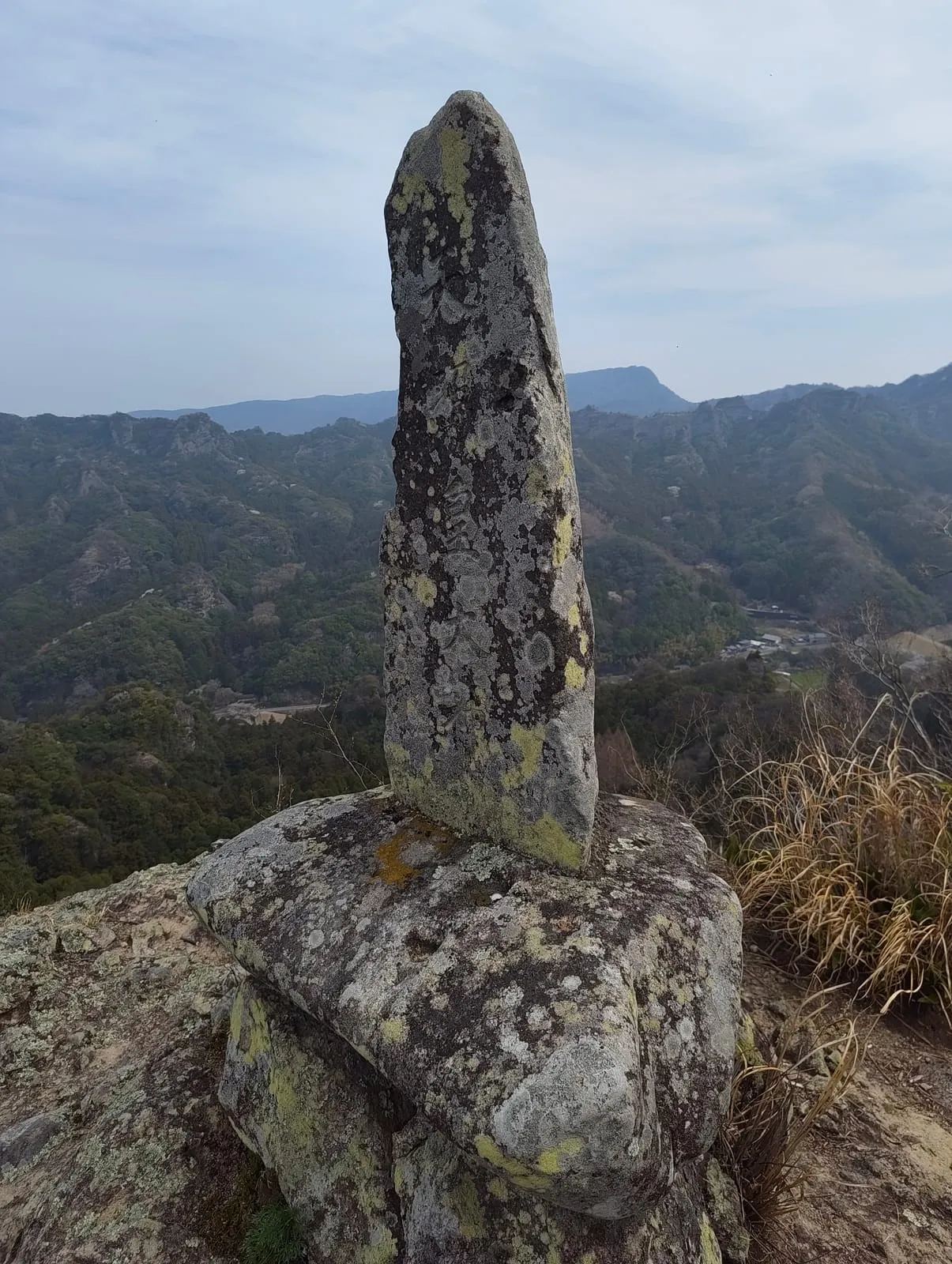
From the summit, the trail drops sharply. At the bottom, after a short walk, it climbs again — into the main event of the day, Nakayama Senkyo.
Nakayama Senkyo is one of the highlights of the Kunisaki Peninsula Minemichi Long Trail. As I mentioned on day two, I wasn’t used to chains at all. And waiting for me was a trail full of them.
The elevation is only about 200 meters, but you walk along a rock ridge about one meter wide. For me, it was also a place where my unfamiliar chain technique would be tested. There were other hikers, but I was carrying about 10 kg on my back. A big pack restricts how you move. In that state, I climbed the chains using both hands and feet.
It was truly frightening. Your balance changes completely depending on whether you’re carrying a pack. I had no room to take photos or videos. Even when I took a selfie, I couldn’t manage a smile — looking back at it, the fear on my face is obvious.
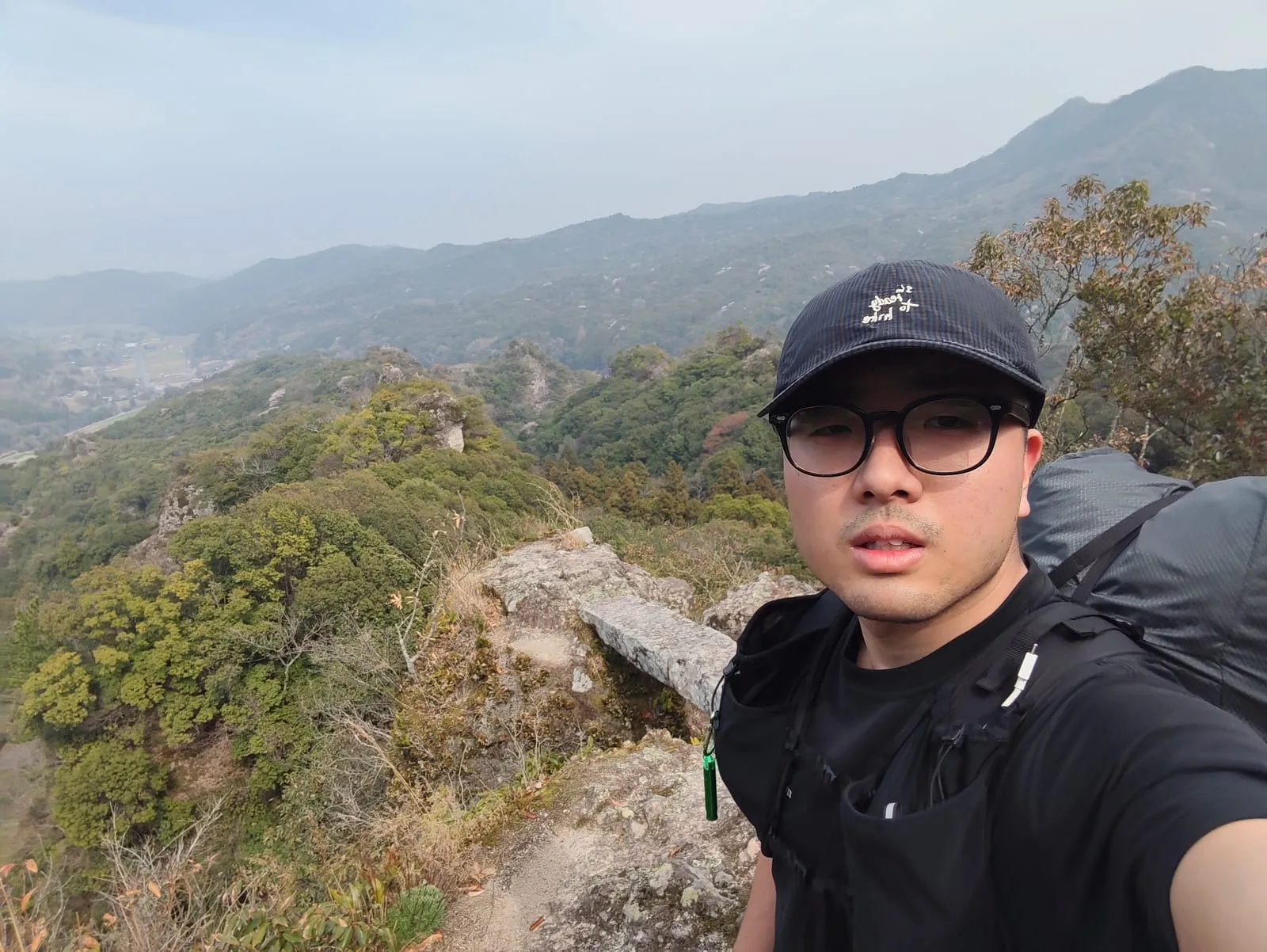
Still, at last the true Kunisaki landscape opened up in front of me. Low mountains, yet an incredible ridge of rock stretched on and on. Looking down from above, it was truly majestic — like the back of a horse, or rather the back of a camel, or even the Great Wall of China.
But this is where I wore myself out, body and mind. My energy, and my spirit too, were badly drained. And yet still ahead were famous spots — and the hardest parts — that could be called the real main event.
By the time I came down from Nakayama Senkyo, it was just past noon. I’d eaten almost nothing since morning, and I sat down by the side of the road. My food was nearly gone and I had almost no water left. Water I could manage, since I had a filter, but I didn’t have enough food to keep going. I didn’t know where I’d sleep that night either. Anxiety and despair left me not knowing what to do.
Then, in the distance, I spotted a single vending machine. Let’s at least walk that far, I thought. When I got there, it turned out to be a hikers’ car park, with more people than I’d expected.
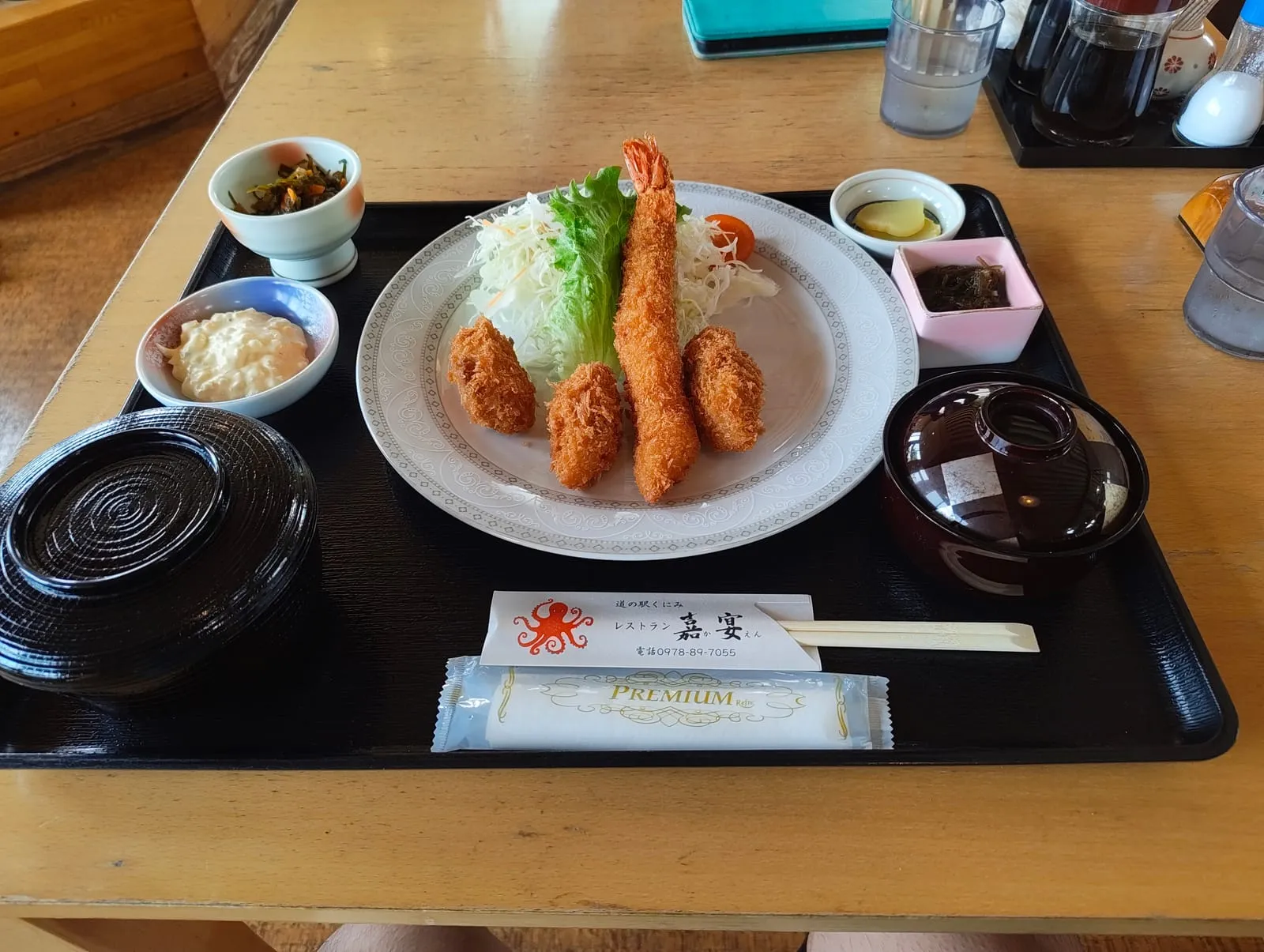
There, two people helped me. One was a woman hiking there, who shared bread and plenty of other food. The other was a man who had come from Beppu to hike. He was incredibly kind and offered to drive me to the nearest place where I could buy food. He was only supposed to take me to a convenience store, but on the way we stopped at a roadside station, and he even treated me to lunch. That meal touched my heart more than any other on the trip.
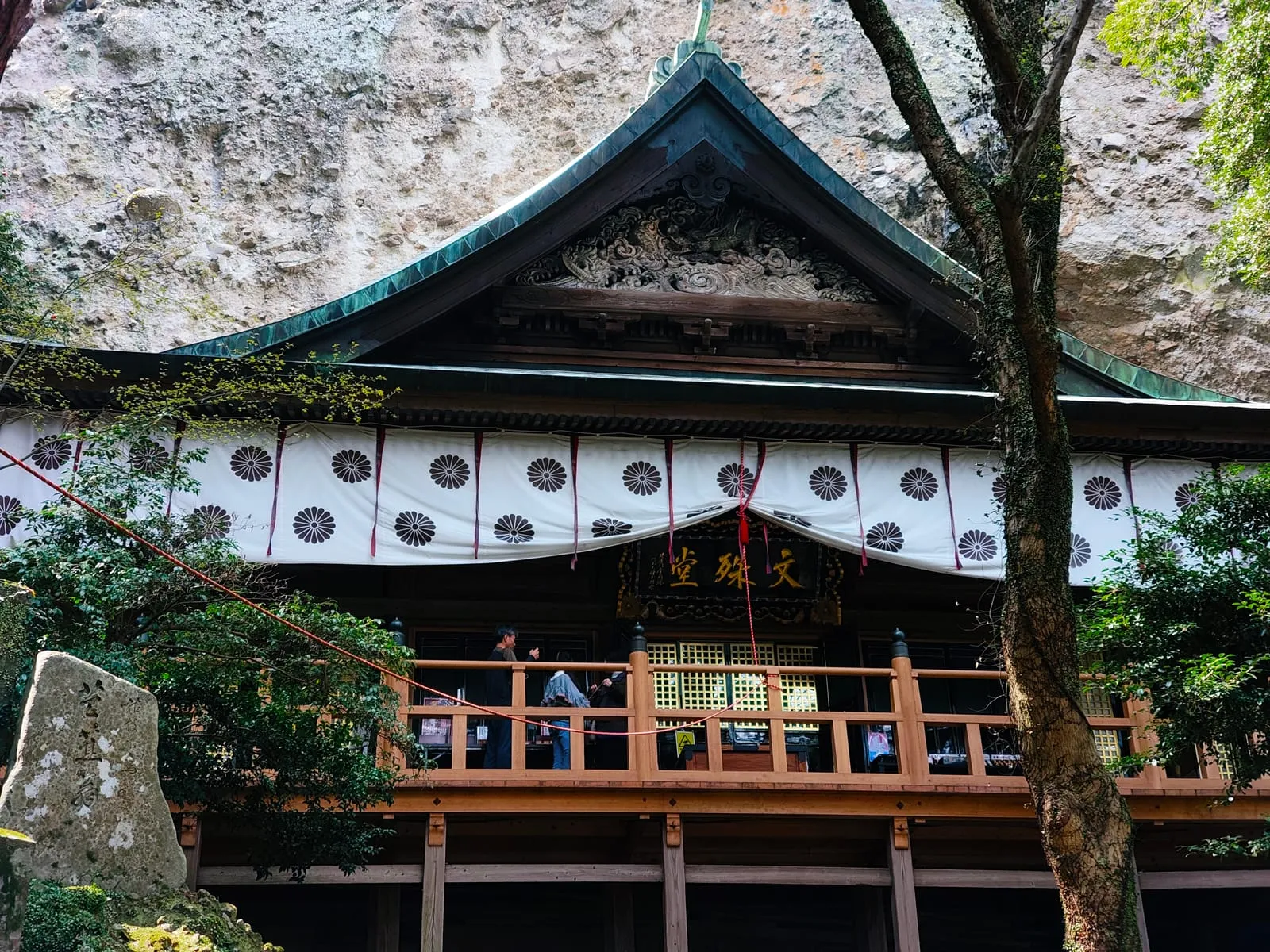
In the car, I told him how close I was to giving up on the trail. He offered to take a shortcut and drive me to Monjusen-ji Temple. At that moment, I was truly grateful. We visited Monjusen-ji together, and said goodbye there.
Looking back, I do have some regrets. That stretch is full of highlights, and I skipped most of them. Still, it’s also true that being able to restock on food there gave me the will to keep going.
When I reached Monjusen-ji, it was around 3 p.m., with only about three hours until sunset. From there I walked about 12 km, and spent that night beside Gyonyu Dam.
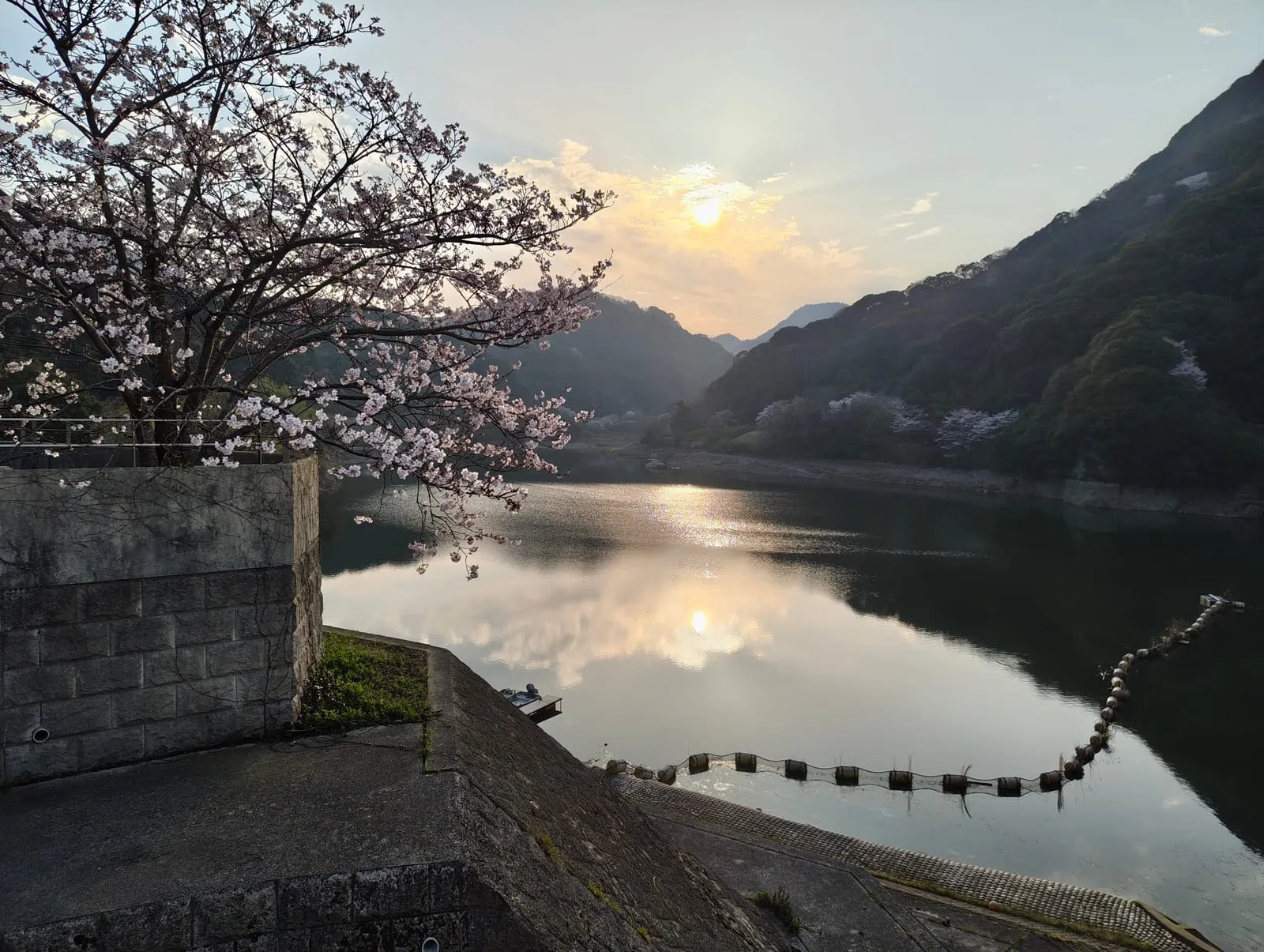
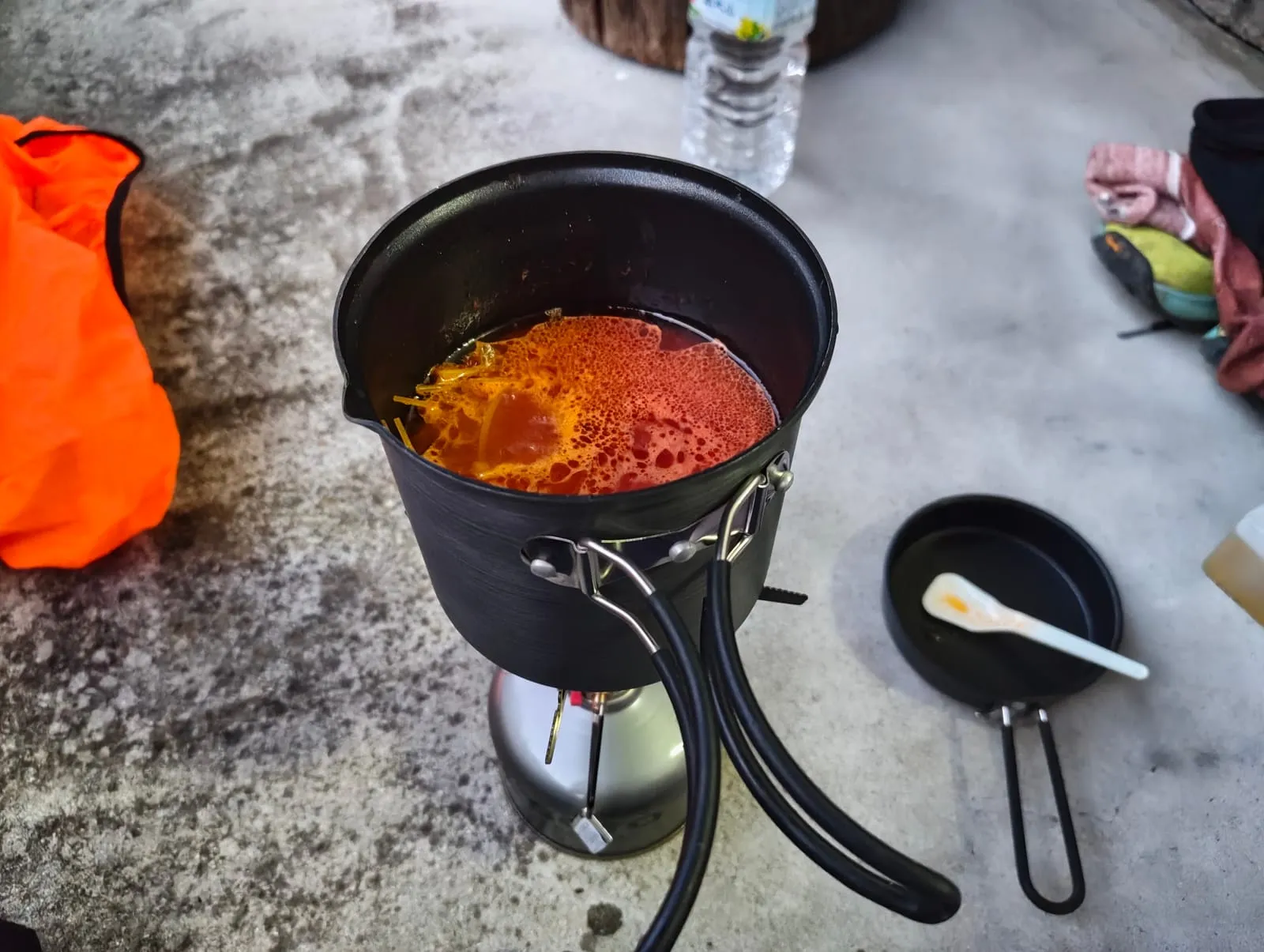
The cherry blossoms were just starting to open. The sunset, the dam lake and the blossoms came together perfectly, and I got to eat dinner surrounded by that view. Dinner was tomato and sausage pasta, made from sausages I’d bought at the convenience store and a pasta kit I’d brought along. It was probably the best thing I ate on the whole trip. That night, in such a pleasant setting, I slept soundly.
Day 4 — Crows, pollen, and my first beer in four days
But when I woke up, some of my gear was gone. Maybe because it was a breezy spot on high ground, there were a lot of crows around. I had left some things outside to dry. I’d assumed no birds would be around at night — but apparently the crows got up earlier than I did. They had neatly made off with my medical kit, and only my medical kit.
It held all sorts of things. My lifeline in case I got sick had been cut. It was quite a shock, but I decided it wouldn’t seriously affect the trip, and kept walking. Even so, I still hold a bit of a grudge against that crow — whichever one it was.
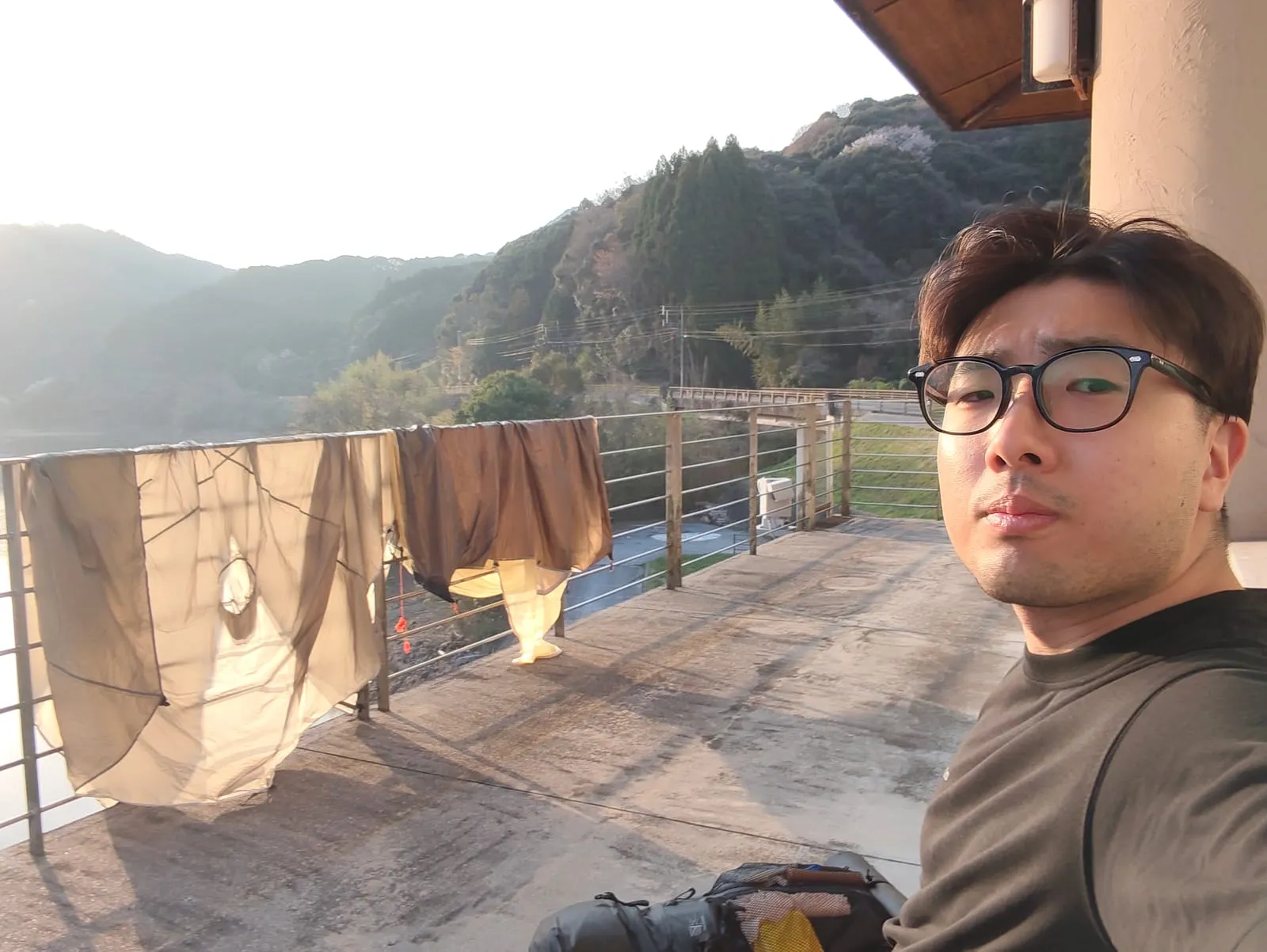
The forecast for the day was rain from the afternoon, and I was feeling worse. My eyes were bleary, and I couldn’t tell whether it was pollen or I was simply ill. Now I sometimes think I should have pushed on. But with rain on the way, I decided to keep the day to about 13 km. I took my time over breakfast and set off late.
I strolled along country roads through farmland, stopping to chat with the older women I met by the roadside. Almost everyone I met was elderly. When I listened to them, the story was the same: there was no one to take over. Without successors, the farms can’t continue, and the rural landscape in front of me might one day disappear. Thinking about that made me very sad.
Lost in those thoughts, I reached my destination, Houon-ji Temple Park, in no time. I visited Houon-ji, and since it was around noon, I had lunch in the park and decided to call it a day.
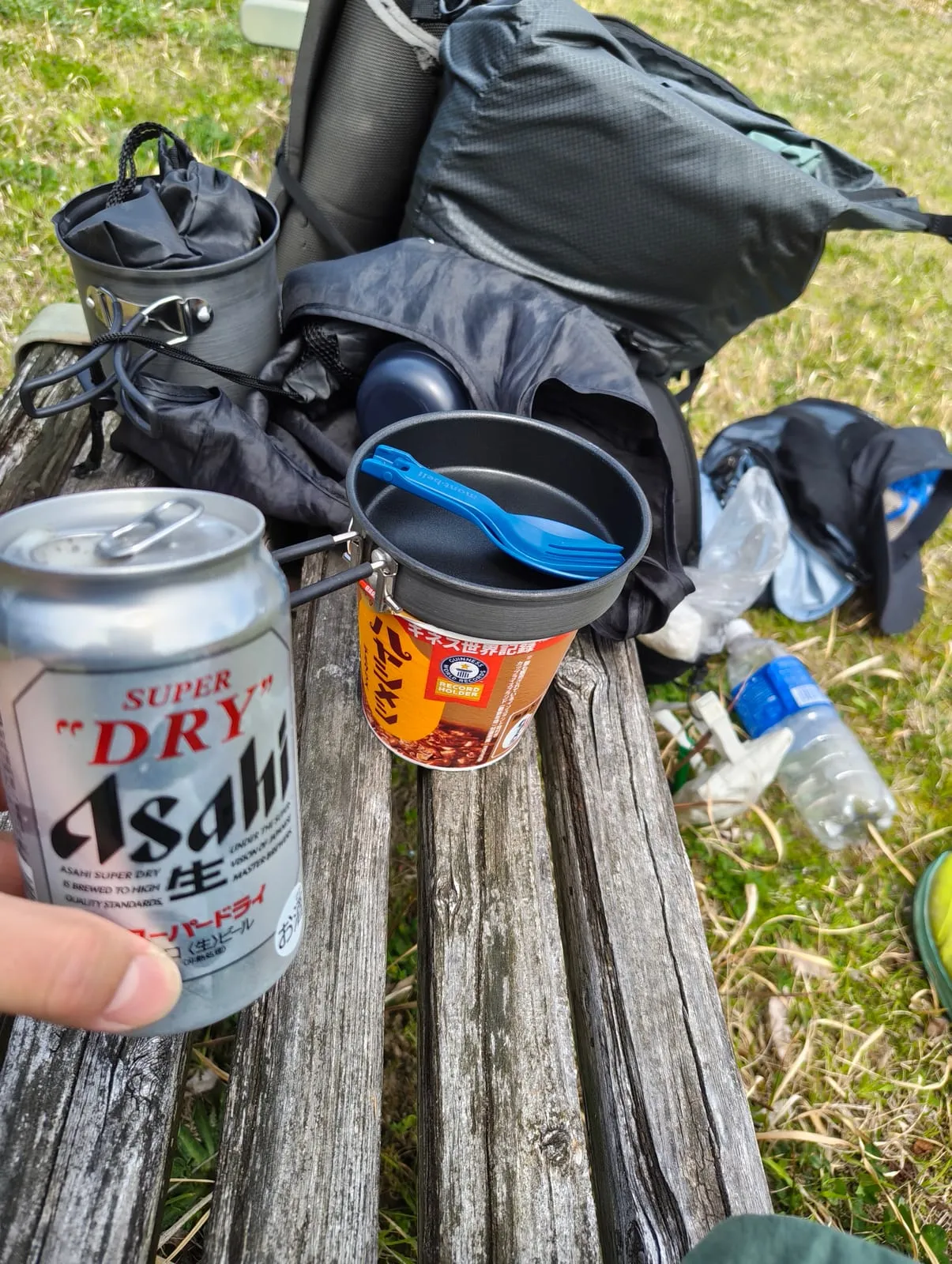
It was a beautiful park, with spreading lawns and cherry trees in bloom — just right for older locals to exercise or relax. By this point the area felt less like a village and more like a small town, and I was able to buy beer at a nearby shop. It was only my second beer of the trip, my first in four days, since Hakata.
I felt fantastic. I bought two cans and had them with an instant curry rice. To be honest, it wasn’t amazing — more like pretty good. Maybe it was the lack of snacks, or maybe it was how I was feeling. Still, drinking a beer while soaking up the sun was something special, and it became a memory I’ll never forget.
The day before, I had booked a room at Minpaku Musashi, a guesthouse about five minutes’ walk from the park. I checked in without trouble and spent the rest of the day taking it easy.
The owner of Musashi was a fascinating person. As soon as I checked in, I was bombarded with questions, almost like a survey: why had I come, and what was I hoping to do? I found that exchange really fun. We talked about my experiences, what I’m working on now, and long-distance trails — a subject I know well — and the conversation kept flowing.
The owner was maybe in their fifties or sixties, very active, and very friendly to foreign visitors — and even spoke English, out here in the countryside. A truly charming person. The guesthouse lets you enjoy the rural scenery, and its inner garden is a wonderful place to relax. It became a very memorable place to stay.
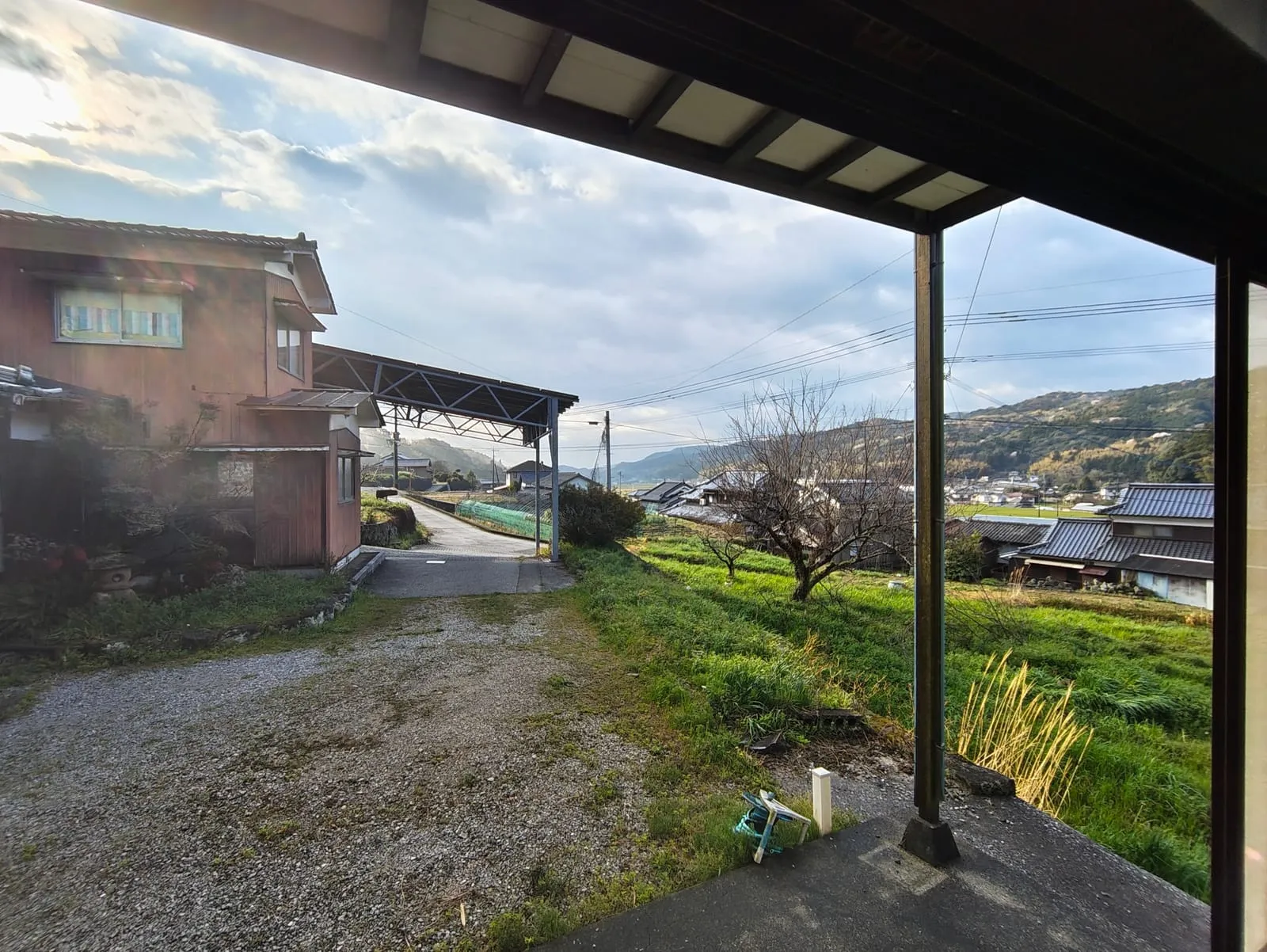
Dinner was a cup of instant noodles, and I was asleep by about 8 p.m. My first bed in days felt incredible.
I agonized over whether to walk one last day. But during the night the wind and rain were fierce, strong enough to rattle the windows. More rain was forecast for the next day, and considering my health too, I finally decided to end the trip here.
After sleeping soundly for about ten hours, I stepped outside to find a lovely break in the clouds after the rain. The relaxed air was mixed with humidity and that distinctive after-rain smell. I thought, “I’d like to stay here another two days.” The atmosphere of the town and the scenery were that comfortable. That’s the kind of place Kunisaki was.
The end of the trip
On the morning of day five, the owner kindly drove me to Oita Airport. From there I headed to Beppu and soaked away four days of fatigue in its hot springs. And that was the end of my trip to Kunisaki.
Why I didn’t finish
Looking back, several reasons came together.
- A poorly planned start. Setting off at midday meant I struggled to find a place to sleep from the very first night. On a trail with so few inns and campsites, I needed to decide in advance how far to walk and where to sleep.
- Inexperience with chains and rock. Climbing chains with a 10 kg pack drained my energy and nerve far more than I’d imagined.
- Food. There are almost no shops around Nakayama Senkyo. Running low on food was what finally broke my spirit.
- Health. Pollen made me feel worse each day, and in the end a crow even took my medical kit.
Why I’m still glad I walked it
Even so, I don’t regret those four days.
The fields of Tashibu no Sho, the stone Buddhas in the rock shelter at Tennenji-yaba, the rock ridge of Nakayama Senkyo — Kunisaki’s landscapes were unlike anywhere else. And above all, there were the people I met along the way: the priests of Kozan-ji and Choan-ji, the hiker who shared her bread, the man from Beppu who treated me to lunch, the older women who told me their stories, and the owner of Minpaku Musashi. Again and again, I was helped by people I would never have met if I hadn’t been walking.
At the same time, I also came face to face with the realities this region is dealing with — fields with no one to inherit them, and very few buses. If more people walk this trail, perhaps people will start flowing back into places like this. That thought is one of the reasons I keep writing about Kunisaki on this site.
For those who will walk it next
Finally, here’s what I learned from walking it.
- Book where you’ll sleep before you set off. Inns and campsites are few and far apart, and camping outside designated campsites is not allowed on this trail. You’ll find lodging and campsites in Water, food & lodging.
- Start early. Many stretches have long gaps between places to stay (see the thru-hike plan and distances between lodgings). If you start at midday, you won’t reach your lodging before dark.
- Carry plenty of food. Shops are few, and around Nakayama Senkyo there’s almost nothing (see water and food along the route). A water filter is reassuring.
- Be ready for chains. Tennenji-yaba and Nakayama Senkyo both have chain sections (see section T-3 and T-4 details). Keep your pack as light as you can, and don’t push it in the rain.
- Keep your health kit close. Spring is also pollen season. Don’t leave medicine or your medical kit lying outside. Crows get up earlier than you think.